
by Vrinda Nair and Swaraj Choudhary
Elisabeth Noelle-Neumann’s Spiral of Silence
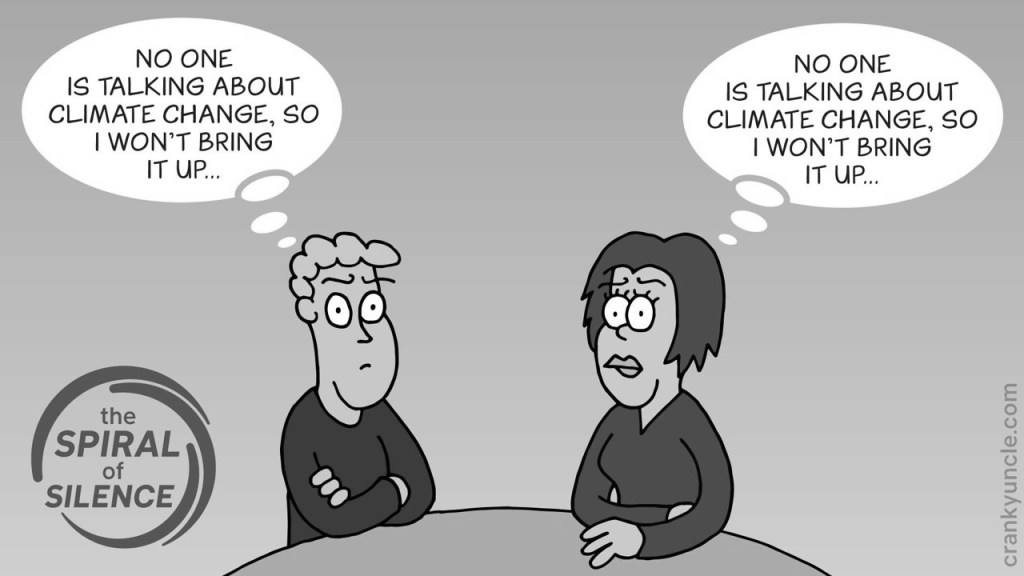
The Spiral of Silence is a theory proposed by German political scientist Elisabeth Noelle in 1974. It explains why people often opt for silence when they sense that their views differ from the majority opinion. This theory suggests that humans fear social isolation, and this fear compels them to withhold dissenting opinions that conflict with the majority in order to preserve their social status.
As social beings, we have a basic and innate need to form communities, unions, and associations. But our reputation matters to us, and we often choose silence out of compulsion to protect it. In such situations, individuals may not have the luxury to express their views openly. This silence is not necessarily due to ignorance or apathy, but rather a strategy of self-preservation in environments where expressing certain opinions could lead to backlash or marginalization. For instance, a Muslim scholar appearing on a news show anchored by a pro-Hindutva journalist is much more likely to take a moderated stand on Islam, one that is agreeable with the audience present there.
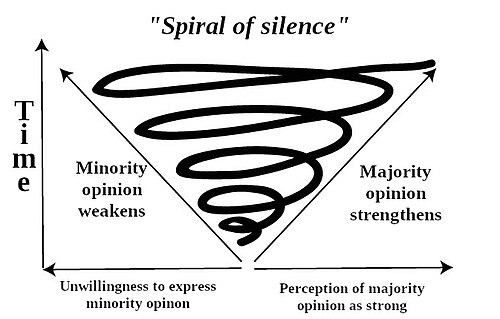
The theory suggests that we possess a “sixth sense” that helps us gauge the prevailing majority opinion in society. When someone believes their view contradicts the majority opinion, they are less likely to speak up. This results in a spiral of silence. As fewer people express dissent, the dominant opinion appears even more widespread. This further discourages others from speaking out.
The theory argues that for an individual to descend into a spiral of silence, there must be some prerequisites. These preconditions are- an issue of public interest, divisiveness on the issue, a sense of the climate of opinion so the individual is able to place their view as majority or minority, a fear of isolation on the part of the individual, and finally the individual’s belief that a minority opinion isolates them from social interaction with others.
This theory is especially relevant in advertising and public communication. Agencies must propose ideas that align with public opinion. This is because any message that goes against the perceived majority’s opinion risks being rejected. Opinions must be in sync with the dominant narratives. Otherwise, individuals or brands face the risk of being ostracized. If a brand dares to say an unpopular opinion, backlash comes swiftly in the form of cancel culture on social media.
The most pertinent example in this regard is the advertisement done by Tanishq only a few years ago that showed a Hindu girl being given love, care and respect for her culture in a Muslim household. The ad sought to challenge the dominant narrative of Hindus vs. Muslims by showing that it is possible to coexist in peace. But it was met with severe backlash on account of the majoritarian view that the ad promoted love jihad and diluted the significance of ceremonies conducted in the Hindu culture. The ad was eventually taken down by the company.
Mass media plays a critical role in reinforcing the spiral by deciding what is mainstream or acceptable. The closer one’s view aligns with the majority, the more likely they are to express it.
In summary, the Spiral of Silence theory argues that fear and social pressure shape whether individuals choose to express their opinions or not, particularly in situations where their reputation is on the line.
 Naren Singh Rao Lectures