
by Anushhka Kalucha
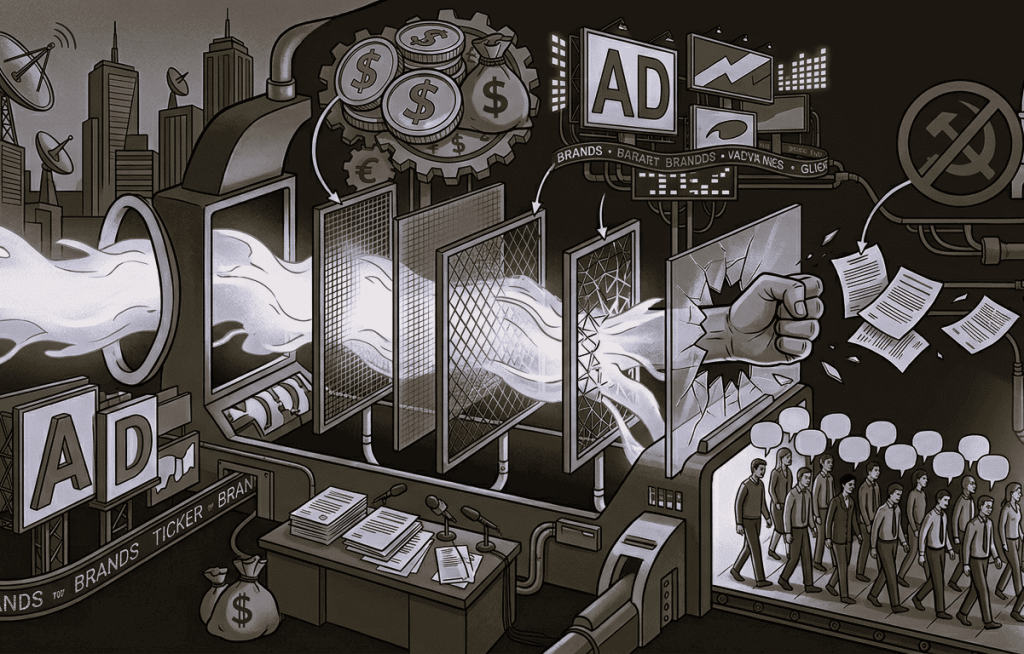
In today’s world, the media plays a powerful role in shaping how people think, what they believe, and how they understand reality. While the media is expected to provide fact-based and truthful information, it is often influenced by profit motives, corporate interests, and political agendas. This phenomenon is commonly described as “manufacturing consent,” a concept that explains how media can shape public opinion in favor of powerful institutions.
What is Manufacturing Consent?
Manufacturing consent refers to the process by which the media influences public opinion to support the interests of corporations, governments, or elites. Instead of presenting purely objective information, media content may be filtered or framed in ways that serve specific interests.
The core idea is that media do not just report news, but also construct narratives that guide how audiences interpret events.
The 5 Filters of News Media
According to this concept, news passes through five major filters before reaching the public:
1. Size and Profit Orientation
Modern media houses are large corporations. Since they operate as businesses, their primary goal is profit. Because of this, media organizations may avoid reporting stories that could harm their financial interests or those of their owners.
Fact-based information is essential, but the media often prioritizes what is profitable over what is purely truthful.
2. Dependence on Advertising
Most media outlets earn revenue through advertisements. This creates dependency on advertisers.
- Advertisers influence which content is promoted.
- Public interest stories may be ignored if they conflict with corporate interests.
- The media may avoid criticizing companies that financially support them.
As a result, corporate media often favours advertiser-friendly content.
3. Sourcing of Information
The media relies heavily on official sources such as governments, corporations, and powerful institutions for information.
However, this dependency can create:
- Conflict of interest
- Limited perspectives
- Biased narratives
For example, if government sources dominate news coverage, alternative viewpoints may be underrepresented.
4. Flak (Negative Responses)
“Flak” refers to negative responses, criticism, or backlash faced by media outlets when they publish unfavourable stories about powerful groups.
This can include:
- Legal cases
- Public criticism
- Pressure from corporations or governments
Because of fear of backlash, the media may avoid publishing critical or investigative reports.
5. Anti-Communism/ Ideological Bias
Historically, American media showed strong anti-communist tendencies. Over time, this evolved into broader ideological biases.
For example:
- Muslims and Islamic communities have often been portrayed negatively.
- Stereotypes and Islamophobia are sometimes reinforced.
- Certain groups are consistently shown in a bad light.
This demonstrates how ideological bias can shape media narratives and influence public perception.
Corporate Media and Public Interest
The responsibility of the media should be to serve the public interest. However, when the media is controlled by large corporations, it may prioritize private interests over public welfare.
Small independent media houses may not have strong corporate biases, but major media organizations are often influenced by economic and political pressures.
In many cases:
- Public interest is overshadowed by corporate goals.
- Information is modified to fit certain agendas.
- Truthful reporting may be compromised.
Conclusion
The media is one of the most powerful institutions in society. While it has the potential to inform, educate, and empower, it can also shape and manipulate public opinion through economic, political, and ideological influences.
Understanding the concept of manufacturing consent helps audiences become more critical and aware consumers of media. Instead of accepting information at face value, individuals should question sources, examine biases, and seek multiple perspectives.
In a democratic society, the media should prioritize truth, diversity of viewpoints, and public interest over profit and power.
 Naren Singh Rao Lectures
Leave a comment