
by Nishtha Ranjan and Abhai Singh Tanwar
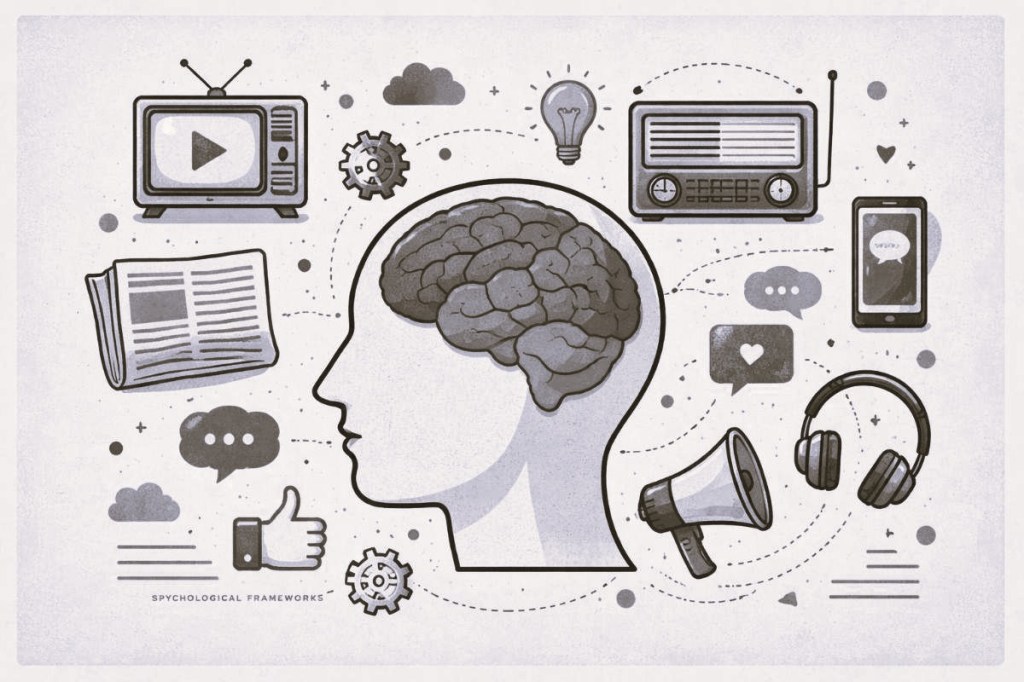
The blog is divided into 2 sections: Psychological Frameworks of Media and its Uses & Gratification. This piece attempts to understand various theories of communication formulated by academicians such as Leon Festinger, George Gerbner, Elisabeth Noelle-Neumann and others.
Psychological Frameworks
Have you ever noticed how some people react when you are trying to communicate the truth to them? But alas, their minds are occupied believing the misinformation (or in some cases, disinformation), which they are not ready to give up without radical arguments.
It’s almost impossible to shake people’s beliefs about something, even when there are factual errors in it. However, there are psychological theories that explain why that happens. There are a number of mental processes working simultaneously or in order. Let’s explore those processes through a series of theories given below.
Cognitive Dissonance Theory
Cognitive Dissonance Theory, first articulated by Leon Festinger in 1957, is a concept that describes an essential feature of human thought.
The theory postulates that people seek consistency among their cognitions, attitudes and behaviour. When these cognitive elements oppose one another, it leads to a feeling of awkwardness known as ‘cognitive dissonance’, which the mind attempts to resolve.
‘Cognitive’ relates to the processes of the human mind that include encoding, processing and storage of information. The term ‘dissonance’ signifies that two or more things are not in line, or in harmony, or out of tune with one another.
Cognitive dissonance occurs when a person holds two opposing beliefs or acts in a manner inconsistent with their beliefs.
For instance, a smoker who learns that smoking is bad for one’s health may experience dissonance because his behavior of smoking obviously calls into question the positive value of a healthy lifestyle. To alleviate their unease, they might change what they believe (say “smoking isn’t all that harmful”), reassess just how serious the health risk is, or even give up smoking.
The theory accounts for why communication for behaviour change is hard work: simple facts may be at odds with deeply held beliefs, generating dissonance that people are averse to. To facilitate attitude and behavior change, messages must be persuasive, persistent, and aligned with the audience’s current values, because dissonance-inducing information is likely to be disregarded or rejected.
In everyday life, from political beliefs to health choices, cognitive dissonance reveals why we cling to consistency and why changing minds is so challenging.
Selective Perception Theory
Selective Perception Theory explains how we automatically filter what we see and hear, letting in only that which coincides with our already established attitudes, beliefs, or experiences. In other words, we perceive the world not as it is but as we are.
This is in large part due to the cognitive dissonance that occurs when we hold two opposing thoughts. The only way for us to bypass this unease is through selective processing, that is, by feeding on information that we already agree with and then interpreting it in a manner that supports our view. The outcome is a closed circuit that considers one viewpoint as the sole correct answer, and others as wrong or simply not pertinent.
One of the most high-profile examples is that of heavily polarised geopolitical issues. For example, if you’ve only been presented with the mainstream view that a region such as Kashmir rightfully belongs to India, then any talk of referendum or self-determination for its people could feel not just wrong but fraudulent and not up for debate. The selective attention screen ignores the complicated history and context of human experience.
In essence, selective perception narrows our reality, reinforcing our biases and making it difficult to understand perspectives different from our own.
Selective Retention Theory
Selective Retention is a psychological theory that explains how we do not retain all the things that happen to us, but instead retain select information subconsciously.
We retain, forget, or choose to ignore information that enters our memory system if it confirms or contradicts what is already in place in terms of what we are interested in, what we believe in, our values, and what we find to be “self-relevant”.
This is how the brain can deal with the massive amount of information it is exposed to daily. It simply chooses to focus on and remembers what it finds to be important or familiar. For example, a violent person is most likely to retain the gory details of a violent picture.
The selective retention theory applies to everything from learning and communication to audience reaction to messages in the media. Our minds retain information that resonates with what we want to know and what we believe. Information that contradicts takes flight, although it does not necessarily disappear completely. Selective retention, therefore, proposes that memory itself is a filter for information we learn. It affects what we remember and what we forget, often in a way that maintains our comfort level with the world.
Cultivation Theory
The Cultivation Theory, created by George Gerbner, explains how television exposure over time affects the viewer’s perception of social reality, rather than affecting a certain behavior. It suggests that TV “cultivates” a common understanding of the world by broadcasting a series of images and ideas.
The theory emerged as a consequence of the growing popularity of television in the 1950s, when television became the primary mass media and began to displace radio, print, and live theater as the primary source of entertainment and information for many families. This sparked curiosity about how a visually-driven, passive medium could affect everyday perceptions and norms.
This theory relies on the principle of slow accumulation. Two significant concepts in this regard are “mainstreaming” (viewers with different perspectives come to share the same ideas because they are exposed to the same television images) and “resonance” (television messages are more believable if they reflect the viewer’s real-life experiences).
Over time, the most frequent television messages about crime, women, money, or relationships come to be accepted as true facts about society. One of the most significant findings of Gerbner’s research is the “mean world syndrome”: people who watch a lot of television tend to see the world as a more dangerous, violent, and threatening place than it really is.
Gerbner’s studies sort viewers by how much TV they watched: light viewers (< 2 hours of watch time), medium (2-4 hours) and heavy (more than 4 hours). Heavy viewing is also linked to a fear of victimization, a lack of trust in others, and a desire for punitive law-and-order policies. These are all examples of second-order effects: changes in attitudes and feelings rather than changes in specific factual beliefs.
Today, the theory is employed not only in the context of broadcast television but also in the context of streaming, social media, and other forms of visual media because the repeated images and stories can still form collective perceptions. The theory has been criticized for not placing enough emphasis on individual differences and audience agency, but the basic premise that repeated messages in the media can form collective views is still relevant to anyone studying media and society.
In conclusion, Cultivation Theory only serves as a reminder that what we see repeated on the screen is important because it helps to form our everyday, taken-for-granted view of the world.
Conclusion
Cognitive Dissonance Theory by Leon Festinger tells us why we tend to align our thoughts, beliefs and actions so thoroughly and why it’s not easy to change for the better. Selective Perception tells us we are not willing to take everything and consider a middle ground for a narrative open to more than one way of looking at things. Selective Retention tells us how selective perception further motivates what we choose to retain in our memory, and what we choose to ignore or forget. Finally, the Cultivation Theory by George Gerbner tells how a leading mass communication channel, such as TV, can impact its audience in developing a pessimistic view of the world and influence polarizing attitudes towards a certain topic.
The Uses and Gratification of Media
Human beings are, at their core, seekers of meaning. Our engagement with the media is rarely accidental. It is guided by an inner hunger to understand, to interpret, and to make sense of the world around us. It explains why people actively choose certain media to fulfil their needs.
Four theories support the argument.
Cognitive Needs
Our cognitive needs- the desire to know, to learn, to explore quietly shape the choices we make every day. Whether we scroll through headlines, analyse a match summary, or read a film review, we are participating in a deeply human ritual: the pursuit of knowledge.
The subjects that captivate us may differ widely. One person may eagerly follow the evolving strategies of cricket, dissecting every over with curiosity. Another may immerse themselves in the layered narratives of cinema, drawn to storytelling and performance. Yet beneath these varied interests lies a shared impulse. We turn to the media not merely for distraction, but for enrichment. We seek clarity, context, and connection. Ultimately, our preferences may paint us in different colours, but the canvas remains the same: an enduring quest to learn more about what fascinates us and, in doing so, about ourselves.
Emotional Needs
Beyond information and intellect, the media also speaks to the tender, unseen corners of our emotional lives. As social beings, we naturally cultivate friendships, relationships, and communities that nurture our feelings and affirm our identities. Yet in moments of solitude and in the quiet hours between responsibilities, we often turn to the media as a companion. Music, sports, political debates, television dramas: each becomes a subtle emotional anchor, capable of stirring joy, comfort, nostalgia, anger, or hope exactly when we need it.
Within the framework of uses and gratification, this emotional engagement is far from passive. We approach media with expectation, almost with intention, seeking stories and sounds that resonate with our lived experiences. Relatability becomes the bridge between audience and content. A homemaker watching a show centered on another homemaker may find fragments of her own struggles, dreams, and daily rhythms reflected on screen. In that reflection, a quiet bond is formed. The character is no longer distant fiction but an emotional mirror. In this way, media becomes more than entertainment; it becomes a space where feelings are validated, identities are affirmed, and solitude feels a little less solitary.
Reference Points
As we grow and move forward in life, we often look for people we can look up to. We need reference points- individuals who represent the kind of success, personality, or lifestyle we aspire to achieve. In the context of uses and gratification, the media play an important role in providing these figures. Through films, interviews, social media, sports coverage, and news, we constantly encounter celebrities, influencers, and public personalities who become our role models.
We do not just watch them for entertainment; we observe them closely. We notice how they speak, how they carry themselves, how they handle success or failure. Gradually, we may begin to adopt certain traits or behaviours that we admire in them. A young athlete may imitate a cricketer’s discipline, while a student may try to mirror the confidence of a public speaker they follow online. In this way, the media becomes a source of guidance and inspiration. It offers us examples of who we could become and shapes our aspirations by giving us visible models of growth and achievement.
Spiral of Silence & Agenda Setting Theory
The Spiral of Silence Theory, introduced by Elisabeth Noelle-Neumann in the 1960s, explains why people often hold back their opinions, especially on controversial topics. The theory suggests that individuals are always watching the opinions around them. If they sense their views are in the minority, they may choose to stay quiet due to fear of criticism, being left out, or social rejection. Over time, this silence makes the dominant view seem even stronger, leading to a “spiral” where fewer people speak up.
In India, this idea is especially relevant. Even though freedom of expression is a constitutional right, many think carefully before sharing their opinions on political or social issues. The fear may not be about direct punishment; it can also involve backlash, labeling, trolling, or social exclusion. On certain topics, even offering a balanced or sympathetic viewpoint can be misinterpreted and labeled as disloyal or anti-national. As a result, people often assess the atmosphere before speaking. The fear of isolation or being targeted leads many to hide their true thoughts. Thus, silence acts as a protective response, even in situations meant to encourage open dialogue.
Agenda Setting Theory refers to the power of the media to shape what people think. It does not directly tell the audience what opinion to hold. Instead, it influences which issues deserve attention. Every day, countless events take place, but the media chooses to highlight only some of them. By repeatedly focusing on certain topics, giving them prime time coverage, larger headlines, or emotional language, the media makes those issues seem more important than others.
This influence operates through techniques like priming and framing. Priming prepares the audience to evaluate people or events in a particular way, while framing presents information from a specific angle. Through these methods, the media can subtly favour certain narratives, portray someone as a hero, or cast someone else in a negative light.
A historical example can be seen during British colonial rule in India. Sections of the British press often described India as backward and uncivilised, promoting the idea that the British were bringing progress and civilisation. At the same time, the resource exploitation and suppression faced by Indians were rarely highlighted in those narratives. In this way, the media helped construct a particular version of reality that supported colonial interests.
Conclusion
In conclusion, the Uses and Gratification theory highlights that audiences are not passive recipients of media but active participants who choose content based on their needs. Whether it is for knowledge, emotional comfort, inspiration, or social awareness, the media serves multiple purposes in our lives. At the same time, theories like the Spiral of Silence and Agenda Setting remind us that the media also shape public opinion. Together, these ideas show the powerful and complex relationship between media and society.
 Naren Singh Rao Lectures
Leave a comment